Why Autonomous XDR Is the Future of Cybersecurity
Introduction
Autonomous XDR is redefining how organizations defend against modern cyber threats. Cybersecurity has entered an era where speed matters more than ever — modern attacks unfold in minutes, often without traditional malware, and span endpoints, identities, cloud workloads, and SaaS applications simultaneously.
In this environment, security teams can no longer rely on manual investigation and reactive workflows. The future of cybersecurity depends on autonomous, AI-driven security platforms that can detect, investigate, and respond at machine speed.
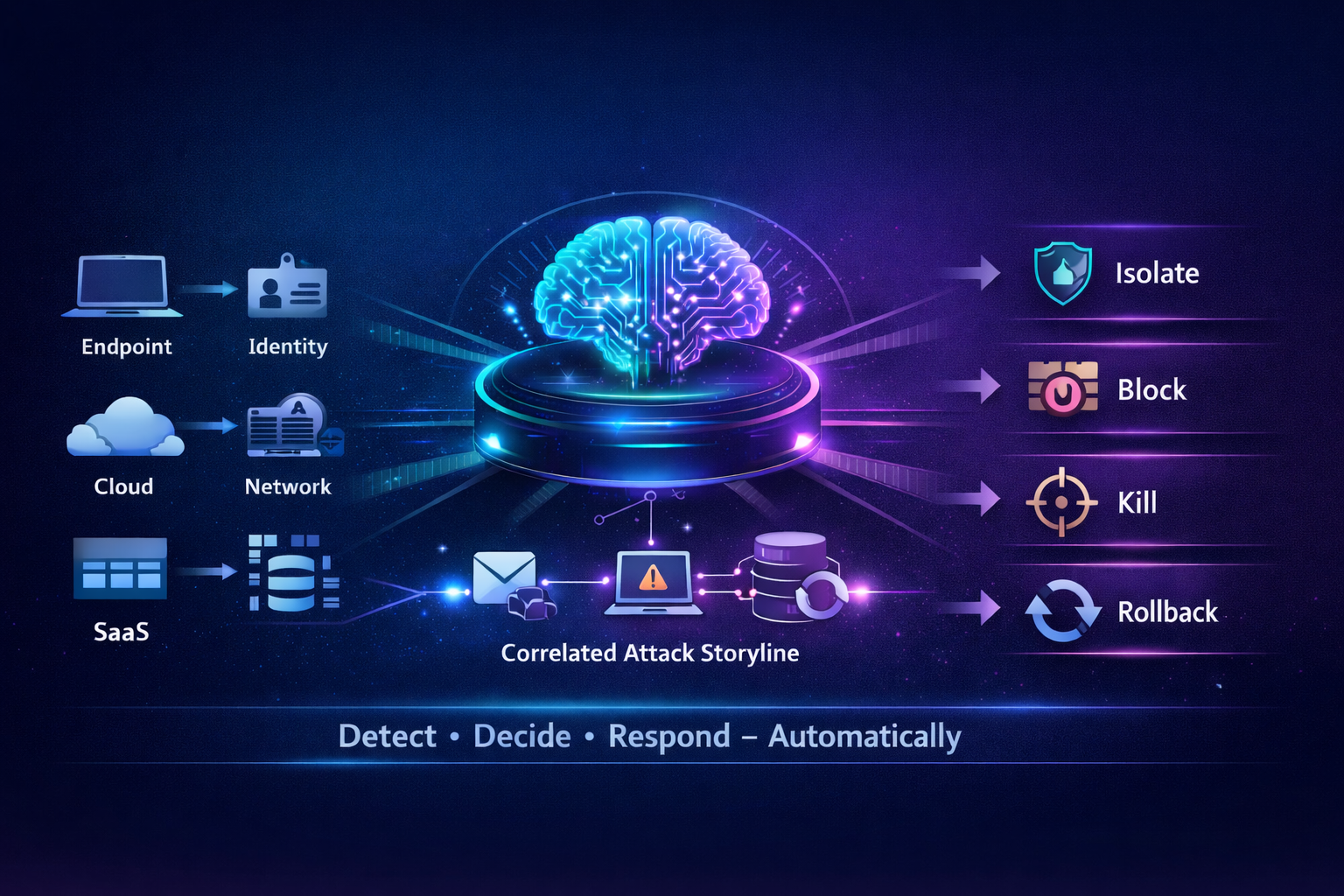
Rather than generating alerts and waiting for human action, Autonomous XDR correlates data, determines risk, and takes action automatically — representing a fundamental shift from reactive security operations to continuous, real-time protection.
The Limitations of Traditional Security Operations
Most traditional SIEM and XDR solutions focus heavily on data aggregation and visibility. While visibility is important, it does not stop attacks on its own. Security teams are often overwhelmed by massive volumes of alerts, many of which are low fidelity or false positives. Analysts spend valuable time manually querying logs, correlating events, and deciding what action to take.
Attackers exploit this gap. They move laterally, abuse credentials, and hide within legitimate tools, knowing that delayed response increases their chances of success. In many organizations, the time between detection and response is measured in hours or days — far too slow for modern threats.
Autonomous XDR and the Role of AI SIEM
Autonomous XDR builds on AI SIEM capabilities to unify security analytics, investigation, and response within a single operational framework. Unlike traditional SIEM platforms that primarily store and query logs, AI-powered SIEM continuously analyzes security telemetry as it is ingested — including structured and unstructured data from endpoints, identity systems, cloud workloads, and integrated third-party tools.
By applying behavioral analytics and machine learning, Autonomous XDR identifies attack patterns that would otherwise remain hidden in isolated data sources. Related activities are automatically correlated into a single attack storyline, giving security teams immediate insight into initial access, lateral movement, and impact — removing the need for manual log correlation and accelerating both investigation and decision-making.
AI SIEM as the Foundation for Scalable Security Operations
AI SIEM provides the scalability required to support Autonomous XDR across large and complex environments. It enables organizations to ingest and analyze high volumes of security data without sacrificing performance or visibility. Advanced normalization ensures that telemetry from different sources can be evaluated together, while built-in enrichment adds context from threat intelligence and behavioral models.
This approach reduces reliance on complex manual queries and static dashboards. Instead, investigations are guided by AI-driven insights that surface high-risk activity automatically. Automation further enhances efficiency by streamlining alert triage, enrichment, ticket creation, and response workflows — allowing security teams to focus on meaningful threats rather than operational noise.
SentinelOne and Autonomous XDR in Practice
SentinelOne delivers Autonomous XDR through the Singularity platform by integrating AI SIEM, endpoint protection, identity security, cloud workload protection, and automation into a single architecture. Rather than treating these domains as separate controls, the platform applies AI-driven decision-making across them in real time.
Storyline-based correlation connects related events across environments into a unified view of attacker behavior. This enables rapid understanding of attack progression without manual investigation. Autonomous response actions are executed directly within the platform, helping organizations contain threats quickly and reduce overall dwell time. SentinelOne has also been recognized in the Gartner® Magic Quadrant™ for Endpoint Protection Platforms for its leadership in this space.
Operational Impact for Security Teams
Adopting Autonomous XDR delivers measurable improvements in security operations. Alert fatigue is significantly reduced as AI prioritizes high-risk activity and suppresses low-value noise. Mean time to detect and respond improves as investigations and remediation actions are automated.
Security teams spend less time reacting to alerts and more time strengthening defenses. The result is improved resilience against ransomware, identity-based attacks, and advanced threats that typically evade traditional detection models. Autonomous XDR allows teams to operate proactively rather than defensively.
The Future of Cybersecurity Is Autonomous
Cybersecurity is no longer defined by the number of tools deployed or the volume of data collected. It is defined by the ability to act decisively in real time. Autonomous XDR represents a shift toward security platforms that do more than inform — they intervene.
As threats continue to evolve in speed and sophistication, organizations must adopt security models that operate at machine speed. The future of cybersecurity belongs to platforms that can detect, decide, and respond autonomously — before attackers gain the advantage.
Frequently Asked Questions
1. What is Autonomous XDR?
Autonomous XDR (Extended Detection and Response) is a security platform that automatically detects, investigates, and responds to cyber threats across endpoints, identities, cloud workloads, and SaaS applications — without requiring manual analyst intervention. Unlike traditional XDR, it acts autonomously at machine speed to contain threats before they spread.
2. How is Autonomous XDR different from traditional SIEM?
Traditional SIEM platforms primarily collect and store log data, requiring analysts to manually query and correlate events. Autonomous XDR goes further by applying AI and behavioral analytics to automatically correlate related activity into attack storylines, prioritize threats by risk, and execute response actions — significantly reducing investigation time and alert fatigue.
3. What is AI SIEM and how does it support Autonomous XDR?
AI SIEM is a next-generation security information and event management platform that uses machine learning and behavioral analytics to analyze security telemetry in real time. It provides the analytical foundation that Autonomous XDR needs to identify attack patterns, surface high-risk activity, and guide automated response — all within a single operational framework.
4. What types of threats does Autonomous XDR protect against?
Autonomous XDR is designed to detect and respond to a wide range of modern threats including ransomware, identity-based attacks, fileless malware, lateral movement, credential abuse, and cloud-based intrusions. Its cross-domain visibility means it can identify attack patterns that span multiple environments simultaneously.
5. How does SentinelOne implement Autonomous XDR?
SentinelOne delivers Autonomous XDR through its Singularity platform, which combines AI SIEM, endpoint protection, identity security, and cloud workload protection in one architecture. Its Storyline technology automatically correlates related events into a unified attack view, enabling rapid response without manual investigation. SentinelOne is recognized by Gartner as a leader in endpoint protection platforms.
6. Is Autonomous XDR suitable for mid-sized organizations?
Yes. Autonomous XDR is designed to scale across organizations of all sizes. For mid-sized security teams with limited analyst resources, the automation and AI-driven prioritization that Autonomous XDR provides is especially valuable — it allows smaller teams to operate at the level of a much larger security operation center.
Conclusion
Autonomous XDR represents the next evolution in enterprise cybersecurity — moving beyond visibility and alerting into intelligent, automated defense. By combining AI SIEM, cross-domain telemetry, and autonomous response, organizations can dramatically reduce their exposure to modern threats and operate with confidence in an increasingly hostile digital environment.
Geodata helps organizations evaluate, implement, and optimize advanced cybersecurity platforms including Autonomous XDR solutions. Explore our cybersecurity resources, client case studies, and blogs to learn more about how we help businesses stay protected.
Learn more about how Geodata supports enterprise security alongside our Microsoft Dynamics 365 Finance services, Power BI analytics solutions, and managed IT services.
Ready to strengthen your cybersecurity posture with Autonomous XDR? Connect with Geodata today and let’s build a smarter, faster defense for your organization.
Author Bio
Fazil Sha
Cybersecurity professional with 6+ years of experience in cyber threat detection, security implementation, and blue team operations. Focuses on strengthening organizational security posture through proactive monitoring, incident response, and risk mitigation strategies.