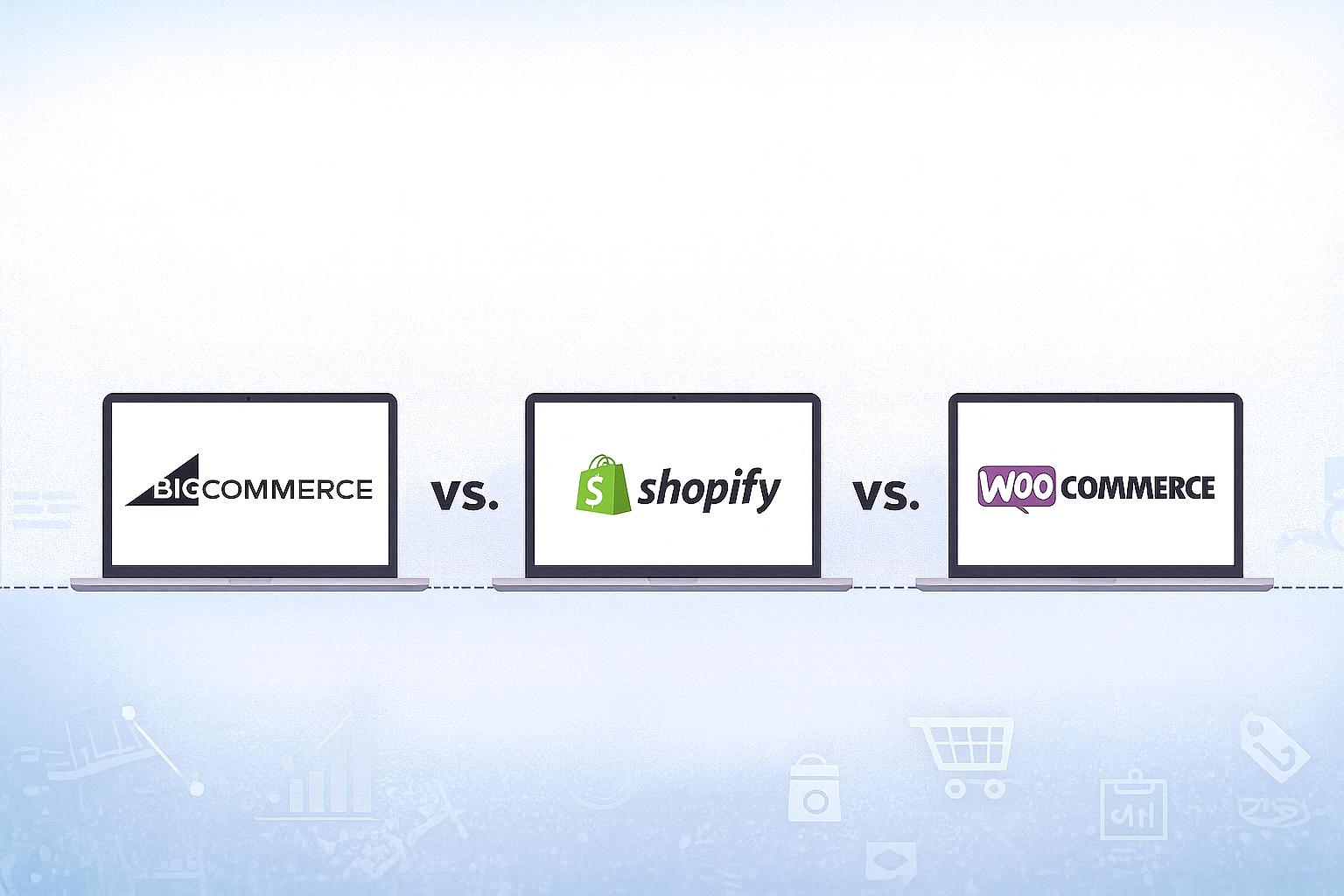
BigCommerce vs Shopify vs WooCommerce: The 2025 Comparison Guide
Introduction
Choosing between BigCommerce vs Shopify vs WooCommerce is one of the most important decisions any e-commerce business will make. The platform you choose today determines whether you scale smoothly or spend the next two years fighting technical fires, surprise fees, and platform limitations.
With U.S. e-commerce projected to exceed $1 trillion in annual sales, the stakes have never been higher. All three platforms are legitimate and battle-tested — but the right choice depends entirely on your business stage, growth goals, and technical resources.
This guide provides an honest, data-backed comparison of BigCommerce, Shopify, and WooCommerce in 2025 — covering fees, features, scalability, and the real costs most comparison guides leave out.
The 3 Questions That Determine Your Best Platform
Before comparing features and pricing, answer these three questions honestly — and one platform will immediately stand out:
- How fast do you need to go live? — Speed to market varies dramatically between platforms
- How much control do you want vs. convenience? — Full ownership vs. managed simplicity is a genuine trade-off
- How big do you plan to grow — and what are hidden fees costing you? — Transaction fees compound significantly at scale
2025 E-Commerce Market Reality
The current market share breakdown shows how dominant these three platforms are:
- Shopify: 26.2% global market share, powering over 2.66 million active stores
- WooCommerce: 20–33% market share across estimates, powering 3.5–4.5 million stores
- BigCommerce: Growing enterprise presence with 0% transaction fees across all plans
- Combined: These three platforms dominate over 70% of the global e-commerce market
The truth is that all three are capable platforms. Your decision comes down to where your business is today and where you plan to take it.
Shopify — Best for Speed and Simplicity
Best for: New stores, D2C brands, influencer-led businesses, and anyone who wants to start selling quickly without technical complexity.
Why Store Owners Choose Shopify
- Launch a fully functional store in 24–48 hours
- Shopify Magic AI builds custom themes and generates product content automatically
- Native integrations with TikTok Shop, Instagram, and Facebook
- 24/7 phone and chat support available on all plans
- Automatic traffic scaling — handles peak events like Black Friday without intervention
- Higher checkout conversion rates compared to many competing platforms
Shopify’s Real Costs
Transaction fees apply when not using Shopify Payments:
- Basic plan: +2% per transaction
- Shopify plan: +1% per transaction
- Advanced plan: +0.5% per transaction
Additional costs to factor in:
- International payment fees: +1.5% on top of standard rates
- Third-party apps add $50–$200+ per month to your bill
- Realistic monthly spend: $100–$300+ depending on app requirements
Real-world impact: A store processing $100,000 per month through PayPal pays $1,000–$2,000 in additional transaction fees annually that BigCommerce users avoid entirely.
BigCommerce — Best for Scaling Without Fee Surprises
Best for: Stores generating consistent revenue at six, seven, or eight figures that are tired of transaction fees eating into margins.
Why Growing Brands Are Switching to BigCommerce in 2025
- Zero transaction fees on any payment gateway — keep more of every sale
- More enterprise features included in standard plans without add-on costs
- Native multi-storefront capability for US, UK, EU, AU and other markets
- B2B Edition includes quotes, sales rep management, and corporate accounts
- Abandoned cart recovery, faceted search, and price lists included by default
- Headless commerce ready with full GraphQL support
- 70+ payment gateways supported with no additional platform fees
Annual Transaction Fee Savings vs Shopify
- $500K/year store: save approximately $5,000–$10,000 annually
- $2M/year store: save approximately $20,000–$40,000 annually
- $10M+/year store: save $100,000+ annually in avoided transaction fees
BigCommerce Limitations to Know
- Slightly steeper learning curve compared to Shopify for new users
- Smaller theme marketplace with fewer out-of-the-box design options
- Annual sales volume thresholds trigger plan upgrades at certain revenue levels
WooCommerce — Best for Content-Driven and Developer-Led Stores
Best for: Content-driven brands, existing WordPress users, and businesses with developer resources who want full ownership and control.
Why WooCommerce Remains a Top Choice
- Free core software — no monthly platform fee
- Full code ownership — you control your data and infrastructure
- Best-in-class SEO through the WordPress ecosystem
- No platform-level transaction fees on any payment processor
- Access to 60,000+ plugins covering virtually any functionality needed
- Ideal for businesses where content marketing drives the majority of traffic
WooCommerce Real Annual Costs
Minimum viable setup:
- Hosting: $250–$600 per year
- Domain and SSL: $10–$50 per year
- Essential plugins: $100–$500 per year
Full production setup:
- Managed hosting: $500–$2,400 per year
- Premium theme: $60–$200
- Premium plugins: $500–$2,000 per year
- Developer support: $1,000–$5,000 per year
What You Are Responsible For Managing
- Security updates and patch management
- Performance optimization and caching
- Hosting reliability and uptime
- PCI compliance for payment processing
2025 Head-to-Head Verdict
| Your Situation | Best Platform in 2025 | Why It Wins |
|---|---|---|
| First store, launching fast | Shopify | Fastest setup, simplest management |
| $500K–$10M revenue, avoiding fees | BigCommerce | Zero transaction fees on all plans |
| $10M+ or complex B2B operations | BigCommerce | Multi-storefront and B2B tools built in |
| Content-focused brand | WooCommerce | Best SEO and WordPress integration |
| Have or hiring developers | WooCommerce | Total customization and code ownership |
| No interest in managing code | Shopify or BigCommerce | Fully managed, hosted platforms |
| Budget under $100/month | WooCommerce | Lowest long-term platform cost |
| Scaling internationally | BigCommerce | Native multi-storefront capability |
Final Recommendation by Business Stage
Launching your first store? Start with Shopify. The speed, simplicity, and support make it the lowest-risk way to validate your business and start generating revenue quickly.
Doing six figures and watching fees grow? Move to BigCommerce. The transaction fee savings alone justify the switch at scale, and the enterprise features reduce your need for expensive third-party apps.
Content-heavy brand with developer resources? WooCommerce gives you full ownership, the best SEO foundation, and the lowest long-term platform cost — if you have the team to manage it.
Understanding Platform Migration Costs
Switching platforms later is expensive — factor this into your decision now:
- Data migration: $2,000–$10,000 depending on catalog size and complexity
- Theme rebuild: $5,000–$30,000 for a fully custom design
- Integration rebuild: $2,000–$15,000 for third-party connections
- Potential revenue loss during the transition period
Choose based on where your business is right now and where you realistically expect to be in 2–3 years. Over-building for hypothetical scale is as costly as under-building for real growth.
Try All Three Platforms Before Deciding
All three platforms offer free trials — take advantage of them before committing:
- Shopify — 14-day free trial
- BigCommerce — 15-day free trial
- WooCommerce — recommended hosting providers
Frequently Asked Questions
1. Which is better in 2025 — BigCommerce, Shopify, or WooCommerce?
There is no single best platform — it depends on your business stage. Shopify is best for new stores that need to launch quickly. BigCommerce is best for scaling businesses that want to eliminate transaction fees and access enterprise features. WooCommerce is best for content-driven brands and businesses with developer resources who want full ownership and control.
2. Does BigCommerce really charge zero transaction fees?
Yes. BigCommerce charges 0% transaction fees across all plans regardless of which payment gateway you use. This is a significant advantage over Shopify, which charges 0.5%–2% per transaction when you use a third-party payment processor instead of Shopify Payments. At scale, this difference can save tens of thousands of dollars per year.
3. Is WooCommerce really free?
The WooCommerce core plugin is free, but running a production store requires paid hosting, premium plugins, security tools, and often developer support. A realistic annual cost for a WooCommerce store ranges from $500 for a minimal setup to $10,000+ for a fully featured production environment. It offers the lowest platform fees but requires more active management than Shopify or BigCommerce.
4. Which platform is easiest for beginners?
Shopify is widely considered the most beginner-friendly e-commerce platform. Its drag-and-drop store builder, guided setup process, and 24/7 support make it possible for someone with no technical background to launch a professional store within 24–48 hours. BigCommerce is slightly more complex but still accessible. WooCommerce has the steepest learning curve of the three.
5. Which platform is best for international e-commerce?
BigCommerce has the strongest native multi-storefront capability, allowing you to run separate storefronts for different regions — such as US, UK, EU, and AU — from a single platform account. This makes it the strongest choice for businesses scaling internationally, as each storefront can have its own domain, currency, language, and product catalog.
6. How does Geodata help with BigCommerce implementations?
Geodata is a BigCommerce partner that helps businesses implement, migrate to, and optimize their BigCommerce stores. From initial setup and data migration to ERP integration and analytics, our team supports the full e-commerce implementation lifecycle. Learn more through our client case studies and e-commerce resources.
Conclusion
When comparing BigCommerce vs Shopify vs WooCommerce in 2025, the right answer comes down to your current business stage, growth trajectory, and technical resources. Shopify wins on speed and simplicity. BigCommerce wins on scalability and fee savings. WooCommerce wins on flexibility and content integration.
The most expensive decision you can make is choosing the wrong platform today and paying to migrate later. Take the time to match the platform to your real business needs — not your hypothetical future ones.
Geodata helps businesses implement and optimize e-commerce platforms alongside broader digital transformation initiatives. Explore our case studies, blogs, and resources to learn more about how we help organizations grow through technology.
Learn how Geodata supports e-commerce businesses alongside our Microsoft Dynamics 365 Finance services, Power BI analytics solutions, and managed IT services.
Ready to choose the right e-commerce platform for your business? Connect with Geodata today and let our experts guide you to the right decision.
Author Bio
Arul